Cable penetrations through fire-sector walls: what ITU-T L.32 says
7 min read
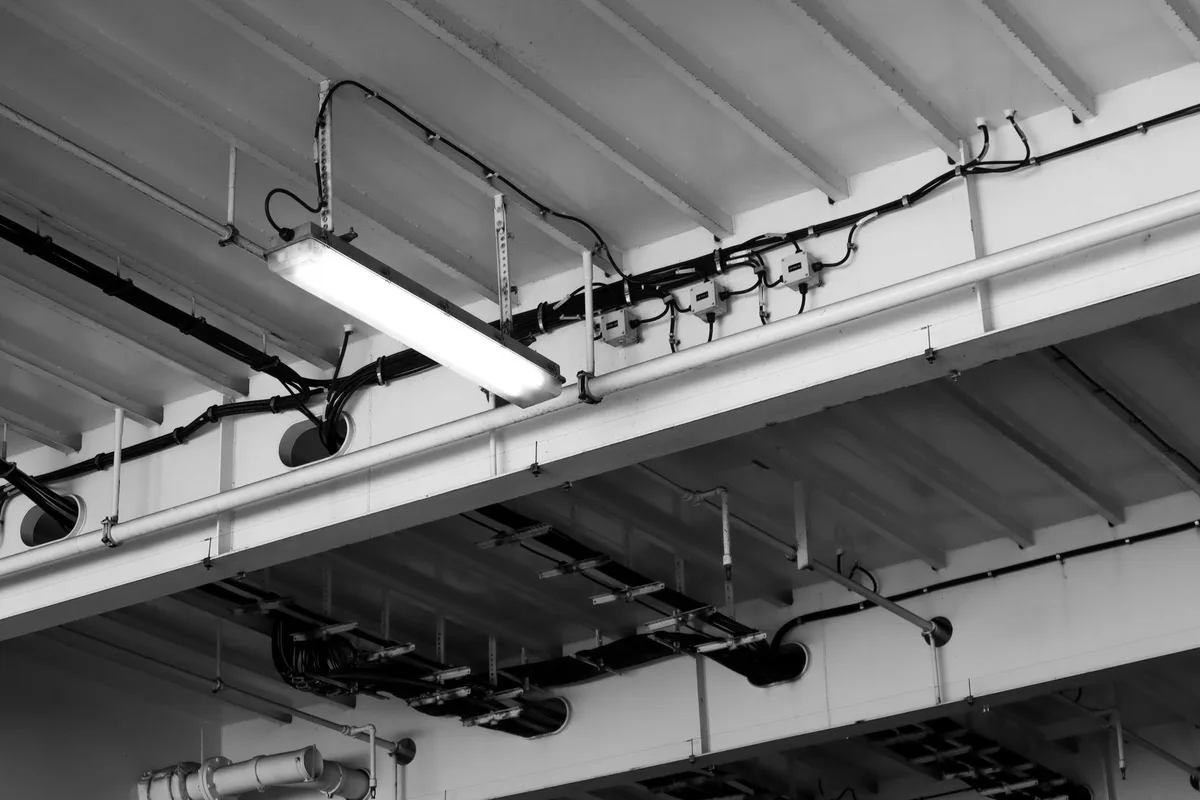
A specification that calls up B2ca on every riser has done half the job. We’ve already covered the cable’s fire-reaction class: what the CPR says and which class you actually need. But a cable with the right code, run through a poorly sealed opening, undoes exactly what that code was meant to guarantee: in a fire, flame and smoke travel where the cable travels, not through the cable. The class belongs to the cable, the seal belongs to the opening: two separate purchases, and a specification almost always covers only one.
What ITU-T Recommendation L.32 says
ITU-T Recommendation L.32 (10/98), Protection devices for through-cable penetrations of fire-sector partitions, dates from 1998 and remains in force today — checked on the ITU site as of writing: thirteen pages in the L series, dedicated to cables. It is not a mandatory standard in Italy: it is an international technical recommendation — but the kind of reference a specification can call up by name, and a test can verify point by point.
It builds on another recommendation, L.22 on fire protection, which introduces the fire sector: a building divided into compartments that must stay separated during a fire. The first: “The elements of the structure which form the boundaries of a fire sector should have fire resistance in spite of through-cable penetration positions” — the boundary elements must keep their fire resistance whatever cable penetrations pass through them: the opening is part of the wall, for fire-resistance purposes, exactly as much as the concrete around it. The second fixes the moment that matters: “The fire resistance of the boundaries should be such as to ensure that the propagation of smoke and fire between fire sectors is avoided before the extinction system is activated” — compartmentation is not a long-term goal, it is the window of time in which extinction still has a chance to work.
And there is the sentence that gives the measure of the problem: “In view of the large number of through-cable penetrations in the fire-sector boundaries of a telecommunication building, which diminish the effectiveness of the fire-extinction system, an appropriate strategy would consist in adopting passive smoke- and fire-control measures” — sealing penetration points with fire-stopping materials, or using cable management systems.
The two clocks: 60 minutes, 120 in higher-risk rooms
Section 2 lists five recommendations: the first calls for fire barriers “to prevent the spread of fire and smoke through openings in fire-sector boundaries”; the third fixes the numbers that matter in a specification — minimum fire separation of at least 60 minutes between sectors, at least 120 minutes between higher-risk sectors, with transformer rooms, rectifier rooms and mains power switching rooms given as examples — testable “by the method given in standard ASTM E814 or by other nationally authorized methods”: ASTM E814, or other nationally authorised methods, leaving the method open, not the requirement.
These are thresholds per penetration: they depend on which two sectors that point separates. A specification that writes “60-minute sealing throughout” without distinguishing the higher-risk rooms — the same rooms that, in a data centre, also set the availability class we’ve written about for the data hall — under-specifies exactly the points that matter most.
The nine conditions for the firestop: re-enterability and certificates
The fourth point lists nine conditions, a) to i), for fire-stopping materials and cable management systems: they prevent the passage of smoke, flame and heat for the minimum time required; they seal quickly whatever shape the opening takes; they pose no environmental or health risk during installation; they resist ageing, stay chemically inert towards the cables, remain thermally stable and non-hygroscopic.
Two conditions matter more than the other seven combined. Condition b): “they facilitate the installation of new or replacement cables while maintaining the original safety conditions” — the system must make it possible to add or replace cables while keeping the original safety conditions intact. No specification ever writes that out in full, and it is the condition that decides whether compartmentation survives the first maintenance job. Condition i): “they have approval certificates from authorized laboratories guaranteeing conformity with the prescribed ratings in respect of correct values: ‘F’ — nominal value for flame transfer to the unexposed environment; ‘T’ — nominal value for heat transfer to the unexposed environment” — approval certificates from authorised laboratories on the nominal F (flame transfer to the unexposed side) and T (heat transfer) values. Without that certificate, no one has verified the declared performance.
The fifth point calls for intumescent material: “When heated, they expand, thereby forming a thick coating which provides isolation from the fire… To obtain a perfect seal, the expansion should be restricted to filling gaps” — heated, it expands to form an insulating layer; for a proper seal, the expansion has to stay confined to filling the gaps.
Appendix I gets concrete: cables through floor openings or shafts, cable-tray penetrations, pipes up to 25 mm in diameter and larger, sector walls inside a cable tunnel. The firestop is sized to the opening’s geometry, not to a generic clause.
How we check it
Knowing that the opening counts as much as the cable does not tell you whether your penetrations hold. [In the spec, beyond the above: re-enterable systems, with a written obligation that whoever adds a cable restores the seal to its original condition and leaves evidence of it; and the count and position of every penetration fixed at design stage, not on site.
Cutting the number of penetrations is a design choice
The second point is the easiest to ignore on site because it belongs to design, not installation: “that the number of through-cable penetration positions be kept to a minimum through the design and management of the cabling network”, with cable management at the points that remain. Every extra opening leaves compartmentation dependent on a job done well once and kept that way for years. Cutting the number — grouping penetrations, sizing them for future capacity rather than opening a new one for every added run — gets decided when the cable route is designed, not when the already-open hole gets sealed.
The penetration register
Condition b) opens a problem the recommendation does not solve on its own: if the seal has to allow cables to be added or replaced while keeping the original conditions, every future job reopens that hole. Without a register — where the penetrations are, which sector they separate, which product seals them, under what F and T certificate, who last reopened them — no one knows, after the first year, who reopened what. Compartmentation isn’t judged by day-one testing, but by the state of the seals today — and only a register kept alive tells you that.
What to write in the spec, what to check at acceptance
In the spec, beyond the above: re-enterable systems, with a written obligation that whoever adds a cable restores the seal to its original condition and leaves evidence of it; and the count and position of every penetration fixed at design stage, not on site.
At acceptance: a visual check of every penetration before ceilings and shafts are closed up — after that, it cannot be inspected without demolition — with a photograph and the product certificate; as-built records with position, sector, required time, product, certificate, date of the last reopening.
The bottom line
The penetration register — where they are, which sectors they separate, which product seals them, who last reopened them — is not only for acceptance: it is the data you need to design a new route through an already cabled building, because it tells you in advance which seals will be broken and who has to restore them. It feeds the same single map of the network on which an AI runs the diagnosis and the crew acts, together with CSIDIA, the group’s other company: on-premise on autonomous machines that do not require deep integration into the existing network, or a dedicated cloud with a data centre in Italy, always with shared management.
Do you need to write or check the fire performance of cable penetrations in a specification, or have you lost track of which seals have been reopened over the years? Talk to a technician: the site visit costs nothing, and the register can start from the next penetration due for inspection, not from zero.