Floating installation: the cable is pushed by water, but how many metres of duct actually take it?
7 min read
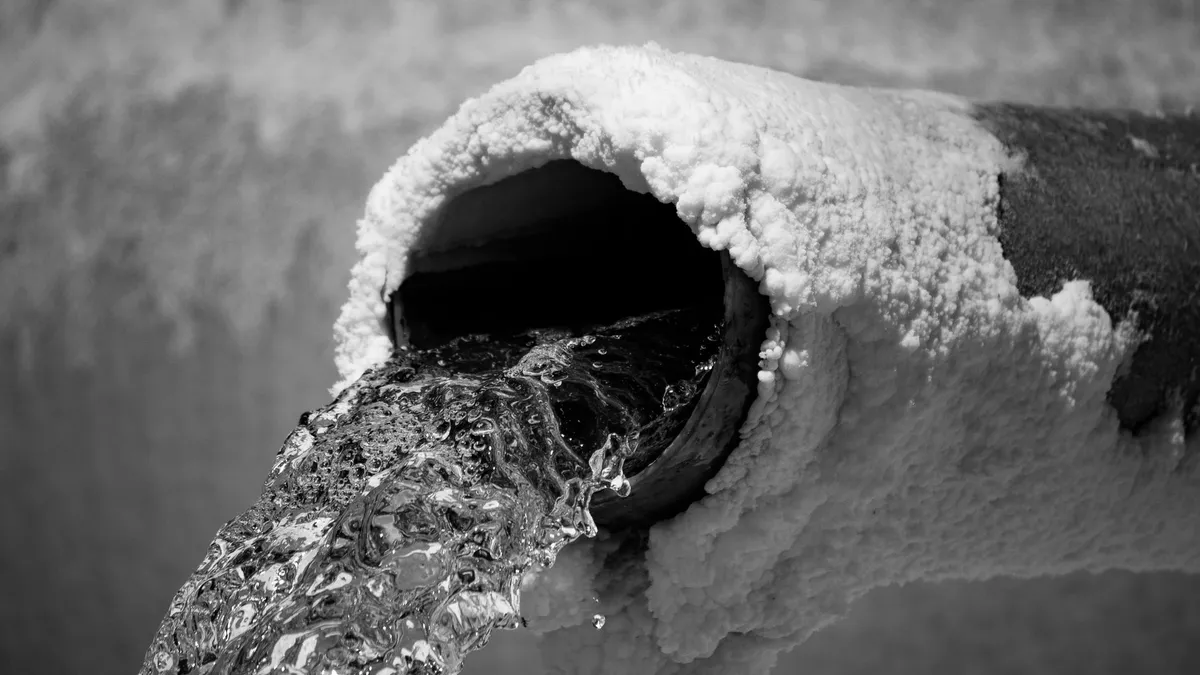
A 50 mm HDPE duct laid on a trunk route fifteen years ago has to take a new cable, heavier than the one it was sized for at the time. The winch is already ruled out: on the route plan, the run exceeds the maximum pulling tension for that cable weight. Air blowing, the alternative that comes to mind first, is built for microcables in microducts a few millimetres across, not for a duct this size carrying a cable at two hundred kilograms per kilometre. There is a third technique, almost never mentioned in a specification: pushing the cable with water. The question that decides whether it works on your route — for how many metres, before an intermediate manhole has to reopen — is not written down in one place.
Not pulling, not compressed air
It is described by ITU-T Recommendation L.61 (07/2004), approved 29 July 2004 by ITU-T Study Group 6. Since 15 February 2016 it has carried the number L.157, renumbered with no change to the text and no republication: the PDF online is still signed L.61, the same single edition in force for twenty years. The Summary: “This Recommendation describes the floating technique to install optical fibre cables in ducts. The floating process described in this Recommendation is always performed by means of water.”
The principle: a pump drives a flow of water along the duct, and the moving water exerts a distributed thrust on the cable, rather than a force concentrated at one end as in pulling. “There are no pulling forces applied at the front end of the cable: that extremity being completely free (with neither rope nor parachute attached).” No rope, no parachute: the leading end goes in free, carried by the flow, at “30 ÷ 40 m/min” — the recommended speed for the caterpillar that regulates the run, and can reverse it, is 40 m/min.
The numbers that decide whether the duct can take it
The Recommendation puts this in numbers, not a general judgement. The reference duct is HDPE, external diameter “40 ÷ 50 mm”: at that diameter it has “allowed the installation of cable lengths up to 6000 m”. Pressure is expressed in NP classes, Nominal Pressure: “A reference value ≥ 6 bar is recommended”, and pumps work in practice between 4 and 10 bar depending on duct class, NP6 or NP10.
Table 1 cross-references cable weight, duct class and maximum floatable length: 100 kg/km in NP10 reaches 6,000 m, the same cable in NP6 stops at 4,000 m; 200 kg/km drops to 4,000 m (NP10) or 3,000 m (NP6); 300 kg/km, the heaviest tabulated, does not exceed 3,000 m (NP10) or 2,000 m (NP6). The heavier the cable, the less duct it will float through at the same pressure class — a figure neither the cable datasheet nor the duct datasheet, read on its own, gives you.
Two geometric limits often ignored at design stage: cable diameter must not exceed “50% of the internal duct diameter”, and the route must avoid “two or more consecutive 90° bends spaced less than 20 m apart” — two close 90° bends stop floating through friction even on a duct that meets the pressure class. On an uphill run, pressure must rise “of about 1 bar per 10 m drop level”: a gradient to know at design stage, not to estimate standing at the manhole.
The water that is needed, and the water that has to leave
It takes real plant, and before that, a duct that has been checked. For a 6,000 m run you need “about 6000 litres of water […] to fill the duct […], and another 2000 litres […] for its laying” — a tanker of roughly 8,000 litres, plus a second tank at the far end. Before starting, the duct passes a continuity test: a piston or a ball “of suitable diameter (around 80% of the inner nominal duct diameter)”, because an undetected constriction stops the cable halfway, not at the end.
The site needs “at least four persons” — reel and machine, intake chamber, receiving end, coordination — with a radio or mobile-phone link between the crews. A point a specification rarely covers: at the end of the job, “according to local rules, the water inside the duct should be recovered” — not discharged into the nearest downstream manhole. Which rules apply, in that municipality, for that volume, is a permitting question, not an installation-technique one.
Where the answer is written — and where it is not written in one place
- The datasheet of the duct as laid: material, diameters, NP6 or NP10 class — often only on the supplier’s old delivery note, rarely in the as-built record.
- The geometric survey of the route: 90° bends, spacing between them, elevation profile — drawn up years ago, rarely updated since.
- The datasheet of the new cable: linear weight, external diameter, minimum bend radius — without these three figures, Table 1 cannot be read.
- The water discharge permit: an authorisation separate from the excavation permit, following the local water utility’s rules, not a technical standard.
- The crew’s own calculation sheet: minimum flow speed and pressure under the Recommendation’s Equation A.4 — usually on a file kept inside the contractor, never handed to the network operator.
- The installation record and the follow-up OTDR trace: length actually floated, any restarts from an intermediate manhole, the continuity-test result.
Six places. The day someone must decide whether that duct will float through to the next manhole, the answer comes from putting them together before the pump is connected — not while the water is already under pressure.
What we do not know
Compliance with L.61/L.157 is voluntary: “Compliance with this Recommendation is voluntary.” Appendix I, “Italian experience”, is informative material — field practice, not a requirement — reporting a floating length “without figure eight procedure” of 4,000 m: less than the 6,000 m normative Table 1 allows under ideal conditions for a 100 kg/km cable in NP10. Theory and what a crew reaches in the field do not, by definition, coincide.
One point we could not clear up: for duct pressure the Recommendation points to ISO 7611:1985 — “(see ISO 7611)”. But in the ISO catalogue today, ISO 7611:1985 is something else entirely: a gas-chromatography method for lemon essential oil, withdrawn since 2006, unrelated to ducts. We have not read it — it is paid — and cannot say whether the ITU-T cross-reference is an uncorrected error. We neither state nor rule out a specific Italian obligation on permits or water discharge for this technique: not verified against a primary national source.
The two axes, applied to a cable pushed by water
First axis: before the manhole is opened, the specification writes down the duct’s pressure class, the bend survey with spacing between the 90°s, the new cable’s weight and diameter checked against Table 1, and the discharge authorisation already obtained — not chased once laying is under way. At acceptance, what gets checked is the continuity test with a signed record and the actual diameter confirmed, the length actually floated against the standard’s limit, and the OTDR trace with no anomalous events at the bends: lines with a number, written where we check specifications, not duct suitable for installation declared without a calculation.
Second axis: the duct datasheet, the bend survey, the cable datasheet and the installation record stop living in separate files and come together, with CSIDIA, into the same single network map — because the decision on a duct due for reopening in five years’ time is made by comparing measurements tied to the same identifier, not starting from zero. On that map an AI checks whether the data is enough to decide and the crew chooses the installation technique — on-premises, on self-contained machines, or a dedicated cloud with a data centre in Italy, always under shared management. It applies as much to optical network design as to a trunk route already in service.
From the site survey, at no cost, we bring the list relevant to your route: duct pressure class found or not, bends recorded in the as-built or not, new cable datasheet available or not, water discharge permit requested or not — including the blank boxes. Talk to a technician: better before the pump is connected, not while the water is under pressure.