Digital Networks Act: Copper Switches Off Area by Area, Not on One Date
6 min read
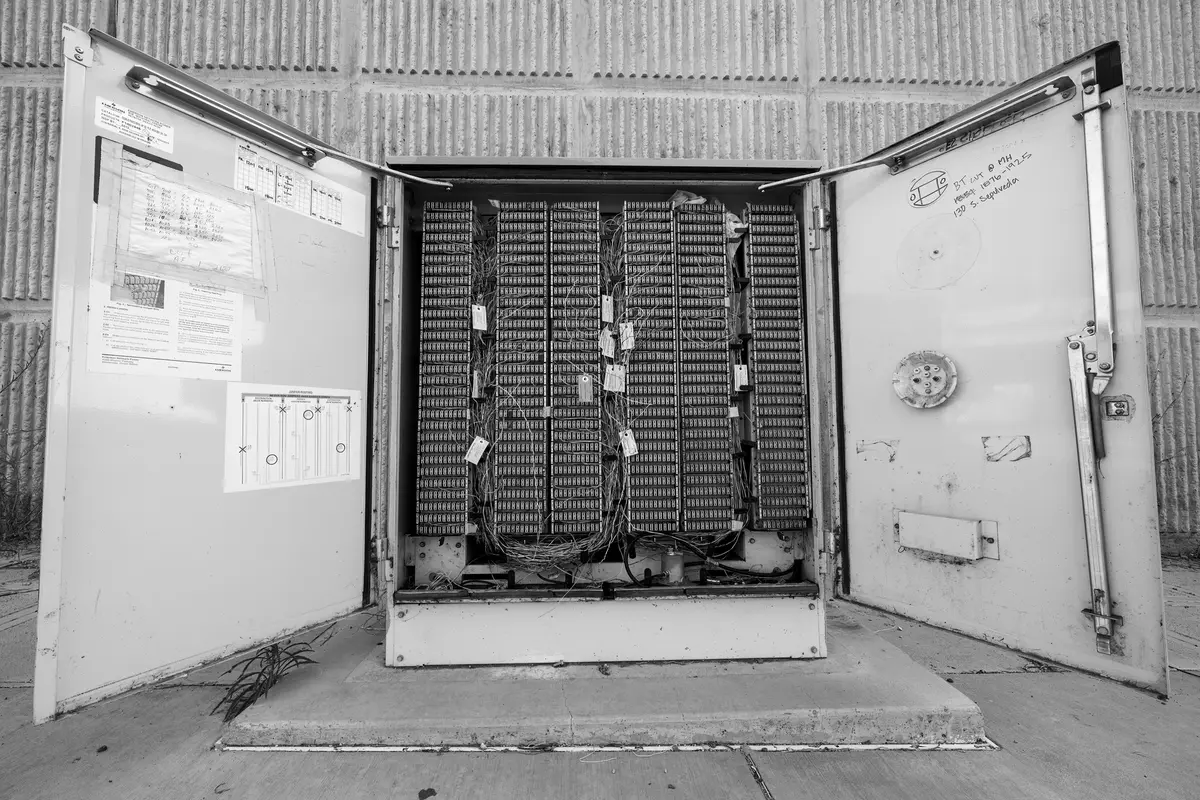
A telephone distribution frame — one of those grey cabinets on street corners or inside exchanges — still holds thousands of copper pairs today, carrying landline numbers, alarms, lifts, POS terminals. On 21 January 2026 the European Commission published the proposed regulation that decides when that cabinet will stop serving any purpose: the Digital Networks Act (COM(2026) 16 final). Anyone expecting a firm date to mark on the calendar will be disappointed: the text does not set a single day for everyone. It sets a threshold, and that threshold is reached at different times, cabinet by cabinet.
It is not 2035, it is 95% fibre plus an affordable offer
The proposed mechanism has two phases. Until 31 December 2035, a member state may order copper switch-off area by area, but only where two conditions are met together: at least 95% of premises reached by a fibre network, and retail offers that are affordable and of comparable quality for those still on copper. Once that date has passed, the conditions fall away: switch-off becomes mandatory even in areas left behind, with a single exception — zones where laying fibre is not economically viable. In practice, 2035 is not “the day copper is switched off”; it is the day the phase ends in which switch-off remains conditional on a real result on the ground.
Italian copper is not Swedish copper
The European framework starts from a far from uniform picture. BEREC’s progress report on copper switch-off (BoR (25) 66, June 2025) captures 31 national regulators as of mid-2025: only 9 countries had already announced a full closure date — from Norway and Spain in 2025 to Malta and Sweden in 2026 — while 14 countries, 11 of them EU member states, had announced no plan at all. Italy sits in the middle, with a peculiarity that matters to anyone working in the field: it began decommissioning in 2024, but only at exchange level — the distribution frames, known as MDFs — without closing the street cabinets that serve neighbourhoods, which remain active. It is the only one of the 17 countries with an MDF closure plan not to also plan for the closure of street cabinets. As a result, most Italian migrations move towards FTTC, not FTTH, and Italy remains among the 21 countries unable to say whether or when they will meet the Commission’s indicative thresholds (80% of lines switched off by 2028, 100% by 2030).
For anyone managing a corporate or institutional network, the operational point is this: fibre coverage on paper and the copper switch-off that actually matters are two different things. An exchange frame can close even while the last stretch to the premises remains a short run of copper down to the street cabinet — FTTC technology, not fibre to the desk. Waiting for a national date before planning the migration of alarms, lifts, data lines and POS terminals still on copper means finding out only when the area switch-off notice arrives: lead times that, according to the same BEREC report, average from six months to two years, and in some countries three to five. Mapping these lines, like any other network asset, is work to do now, not when the operator’s letter arrives.
The other two levers: infrastructure sharing and resilience
The Digital Networks Act does not stop at copper. It introduces symmetric access to in-building wiring — useful for anyone cabling apartment blocks and multi-tenant premises, where the riser is often the real bottleneck — and a harmonised regime for sharing existing passive infrastructure, ducts and poles: reusing them is simpler than opening a new worksite, the same theme we covered in our piece on permits and reinstatement for excavation works. It also establishes a Union Preparedness Plan for Digital Infrastructures, a report that BEREC will have to draw up, together with ENISA and the EU-CyCLONe network, to map the dependencies, vulnerabilities and critical nodes of Europe’s digital infrastructure: for anyone managing critical networks — data centres, healthcare, public administration — continuity during a crisis stops being merely good internal practice and becomes an EU-level requirement.
Who pays for the transition, and who risks being left out
The most contested point is not technical, it is economic. Operators, through their trade associations, are demanding firmer guarantees on transition timescales and on support for the decommissioning costs of private infrastructure that is still operational: a legal analysis published in Il Riformista openly called it “a de facto expropriation” lacking full compensation. On the other side, BEUC, the European consumer organisation, is calling for regulatory simplification not to weaken protections on competition and net neutrality, and is pressing for every national plan to genuinely guarantee — not merely on paper — timely information to users, continuity of essential services towards equivalent alternatives, and access to affordable internet and voice services even after switch-off: two different positions on who pays for a transition that everyone now regards as necessary.
It should be said clearly that, as of late July 2026, the Digital Networks Act is not yet law: it is a Commission proposal (procedure 2026/0013/COD) following the ordinary legislative procedure. The European Parliament’s ITRE committee held a public hearing on 24 June 2026, the Council of the EU finalised its own working document on 23 June 2026, and the trilogue between the two institutions has yet to begin: the dates may change, but the underlying principle — thresholds instead of fixed deadlines, mandatory infrastructure sharing, EU-level resilience — is unlikely to be overturned.
What to do
- Map the copper lines still active — alarms, lifts, POS terminals, analogue switchboards, data lines — before the area switch-off notice arrives: Italy does not yet have a national date to plan against.
- Check with the operator what technology is actually in place at your address: an exchange switch-off does not equate to fibre reaching the premises; it may mean FTTC.
- Write continuity and migration clauses into your specifications, not just laying clauses: timely information, replacement service, defined notice periods.
- If you manage multi-tenant premises or are planning excavation works, follow the rules on symmetric access to in-building wiring and the sharing of passive infrastructure.
- Track the progress of the regulation: the trilogue may still change the dates, not the principle.
The bottom line
Copper will not disappear overnight by European decree: it will disappear cabinet by cabinet, wherever fibre has genuinely reached the threshold the law requires. For anyone managing corporate, healthcare or institutional networks, the useful question is not “when does Brussels say so”, but “what is currently running on copper in my infrastructure”. It is the work we do ahead of every fibre migration: a census of existing lines, verification of the technology actually available, specifications written to withstand a transition that has already begun — even though no one has yet set an end date — for telecommunications networks as much as for public administration infrastructure.
Do you have copper lines whose replacement technology you don’t know exactly, or network specifications with no continuity clauses for the migration? Get in touch: a free site survey and quote, even just to understand what will really change for your premises.
Sources
- EUR-Lex — Proposed regulation COM(2026) 16 final, Digital Networks Act
- BEREC — Progress Report on managing copper network switch-off, BoR (25) 66 (June 2025)
- European Commission — Digital Networks Act, summary
- BEUC — Simplification in the Digital Networks Act must not come at the expense of consumers