In a railway tunnel the cable must be B2ca. In a road tunnel, no rule says so.
7 min read
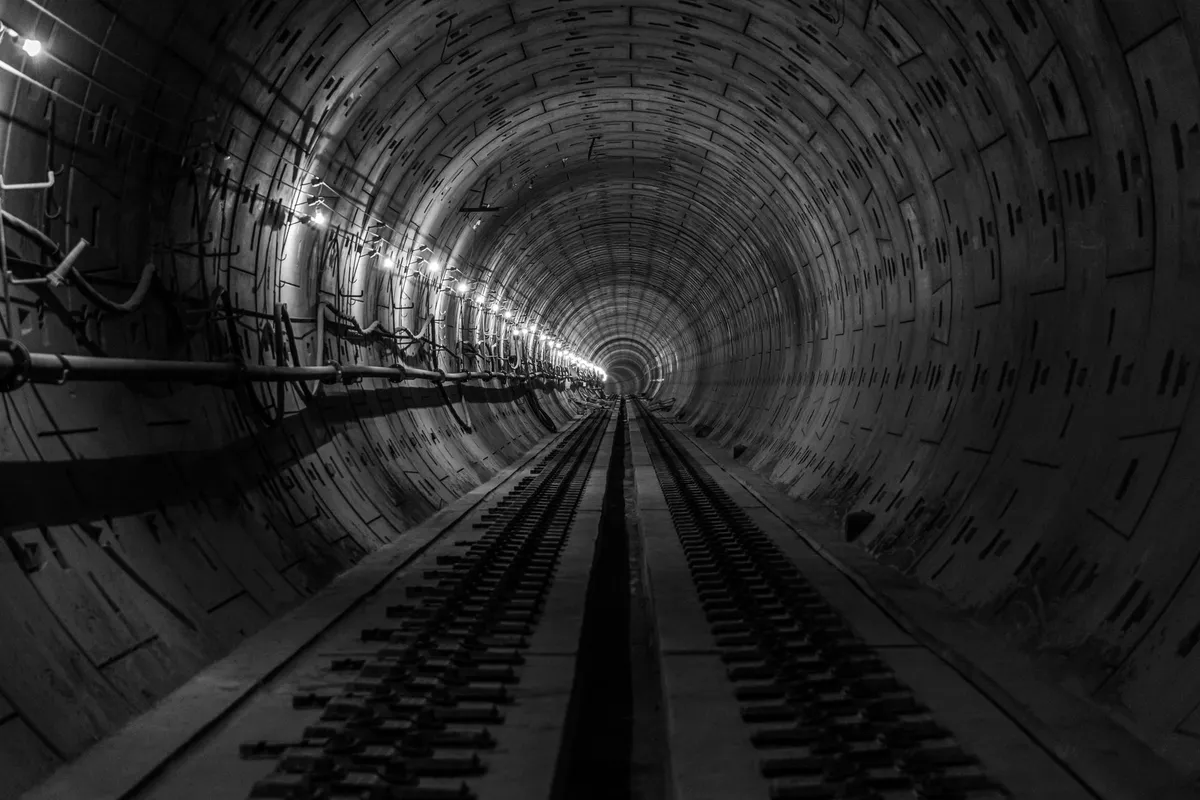
A regional fibre backbone has to cross two tunnels on the same route: a railway one, twelve hundred metres long, where the cable runs in a tray beside the track; a road one, under a slightly shorter rise. The specification writes the same line for both: “flame-retardant cable, suitable class”. It looks like one requirement applied twice. It is not: one of the two tunnels has, written into an EU regulation, a threshold with a precise code. The other does not — and not because the risk is lower.
The international recommendation sets no threshold: it points elsewhere.
ITU-T L.100 (01/2024), Optical fibre cables for duct and tunnel application — the same recommendation that fixes the maximum pulling tension for duct cables — deals with fire safety, at clause 6.4, in a way that wrong-foots anyone looking for a number: “Fire safety in duct and tunnel cables is generally an issue in the installation criteria and possible fire safety restrictions; refer to the regional and national norms.” The same clause adds, where no fire safety specification is provided, a list of IEC standards to consider according to the application: IEC 60332-1-2 (vertical flame propagation on a single cable), IEC 60332-3-24 (vertical flame spread on a bundle of cables, Category C), IEC 60754-1 and IEC 60754-2 (halogen acid gas content and smoke acidity), IEC 61034-1 and IEC 61034-2 (smoke density) — and IEC 60331-25, the only one of the seven written specifically for fibre: Tests for electric cables under fire conditions — Circuit integrity — Part 25: Procedures and requirements — Optical fibre cables, that is, fire resistance — the cable keeps transmitting during the fire — not reaction to fire. None of these seven is an obligation under L.100: they are the list the recommendation itself suggests in the absence of anything else.
In a railway tunnel the threshold has changed twice, and now it applies to every tunnel.
For railway tunnels the number exists, and it is binding in its own right. Commission Regulation (EU) No 1303/2014, the SRT TSI — the technical specification for interoperability on “safety in railway tunnels”, of 18 November 2014 — is a regulation, not a directive: it applies directly in every Member State, with no national transposition needed. In the original text the cable threshold sat at clause 4.2.2.4, applied only to tunnels longer than 1 km, and referred to a 2006 Commission decision. Implementing Regulation (EU) 2019/776, in force from 16 June 2019, rewrote it entirely: it deleted 4.2.2.4 and moved the requirement into clause 4.2.1.3, “Fire reaction of building material”, which applies “to all tunnels”, with no length threshold left.
The current text reads: “Exposed cables shall have the characteristics of low flammability, low fire spread, low toxicity and low smoke density. These requirements are fulfilled when the cables fulfil at least the requirements of classification B2ca, s1a, a1” — the strictest smoke sub-class on the scale, not the generic s1, as distinguished elsewhere — referring to Delegated Regulation (EU) 2016/364, the same one that classifies cables in buildings. Two details a serious specification cannot ignore: “If the classification is lower than B2ca, s1a, a1, the class of cables may be determined by the infrastructure manager after a risk assessment” — not a shortcut for the installer, but a formal, reasoned derogation; and “different classifications of cable may be used for different installations within the same tunnel”, so not a single code good for everything.
In a road tunnel, there is no threshold for cables.
For road tunnels on the trans-European network the source is different: Directive 2004/54/EC of 29 April 2004, which — Article 1(2) — “shall apply to all tunnels in the Trans-European Road Network with lengths of over 500 m”, transposed in Italy by Legislative Decree No 264 of 5 October 2006. Being a directive, it needed a national instrument; and its Annex I, unlike the rail TSI, sets no class at all for cables. Point 2.18, “Fire resistance of equipment”, says only this: “The level of fire resistance of all tunnel equipment shall take into account the technological possibilities and aim at maintaining the necessary safety functions in the event of a fire.” No number, no code: an objective. Point 2.16, “Communication systems”, mandates the equipment — radio re-broadcasting for emergency services beyond 1,000 m in length and 2,000 vehicles per lane, loudspeakers in shelters — but not the class of the cables that feed it.
This does not mean cables in a road tunnel may burn without consequence: it means the threshold, there, is not written by this rule. It has to be taken elsewhere — from the general fire prevention code, following the same logic already set out for buildings — or written into the specification as an explicit choice, not inferred from a regulation that, for road tunnels, is silent on the point.
What to put in the specification.
- Declared scope for every section: railway tunnel (binding SRT TSI threshold, now with no length limit) or road tunnel/other section (no EU-sourced threshold specific to cables) — never the same line for both.
- B2ca-s1a,a1 as a minimum for exposed cables in a railway tunnel, the full code, with an explicit reference to clause 4.2.1.3 of the SRT TSI as amended by Regulation (EU) 2019/776.
- A traceable derogation: if the class drops below B2ca-s1a,a1, the infrastructure manager’s risk assessment attached to the documentation, not a note in a site diary.
- Classes differentiated by installation, where the project requires it, each one declared rather than generalised across the whole tunnel.
- For road tunnels, the class chosen with the same criterion as the fire prevention code already set out for buildings: never left to an adjective.
- Fire resistance kept separate from reaction to fire for cables feeding fire detection or emergency communication: an IEC 60331-25 test for optical fibre, not inferred from the “ca” code.
- Access to technical rooms and splice enclosures governed like any other safety installation in the tunnel, with a handover record and intervention windows agreed with the infrastructure manager, because acceptance testing cannot stop operations.
How to check it at acceptance.
Reading “B2ca” on the sheath is not enough: ask for the Declaration of Performance for the exact article code and check that it states the full code, sub-classes included — the same check already set out for building cables, applied here to a different threshold. For cables feeding safety systems, also ask for the test report to IEC 60331-25, not just the reaction-to-fire data sheet: these are two different performances, and the second cannot be inferred from the first. Finally, check that the scope declared in the specification — railway tunnel, road tunnel, any derogation by the infrastructure manager — matches the section as built, because that scope decides whether B2ca-s1a,a1 is a regulatory obligation or a choice made by whoever wrote the specification.
The point.
A burning cable in a tunnel does not distinguish between rail and road: the flame behaves the same way in both. It is the legal text that distinguishes, not the risk — which is why the threshold has to be written explicitly every time, never inferred from the type of infrastructure. That is why, when we design a tunnel installation or write a specifications and compliance document, the fire reaction class of the cables and the fire resistance of those feeding the alarm become two distinct clauses, each checked at acceptance against the right test report — not the code printed on the sheath — and delivered together with the test results. Every section run through a tunnel feeds into the same single network map we build for the as-built record of a backbone: not a file that ages in a drawer, but data an AI can cross-reference — matching a fire alarm against the fibre section running alongside it — before a team has to go looking for it by hand, for an operator, a public authority, a defence site or a data centre relying on that tunnel for interconnection. Where an AI is needed on network data, it runs within the client’s perimeter — on-premise or on dedicated cloud with a data centre in Italy — alongside CSIDIA, the group’s other company.
Do you need to run a backbone through a tunnel, railway or road, or review a specification that treats them both the same way? Talk to an engineer: the site visit is free, and the right code is written before the cable is ordered, not at acceptance testing.
Sources
- ITU-T L.100 (01/2024) — Optical fibre cables for duct and tunnel application
- Regulation (EU) No 1303/2014 (SRT TSI), as amended by Implementing Regulation (EU) 2019/776 — amending text
- Directive 2004/54/EC — minimum safety requirements for tunnels in the trans-European road network
- Normattiva — Legislative Decree No 264 of 5 October 2006 (transposing Directive 2004/54/EC)