G.652 or G.657: Which Fibre to Specify for Tight Bends?
6 min read
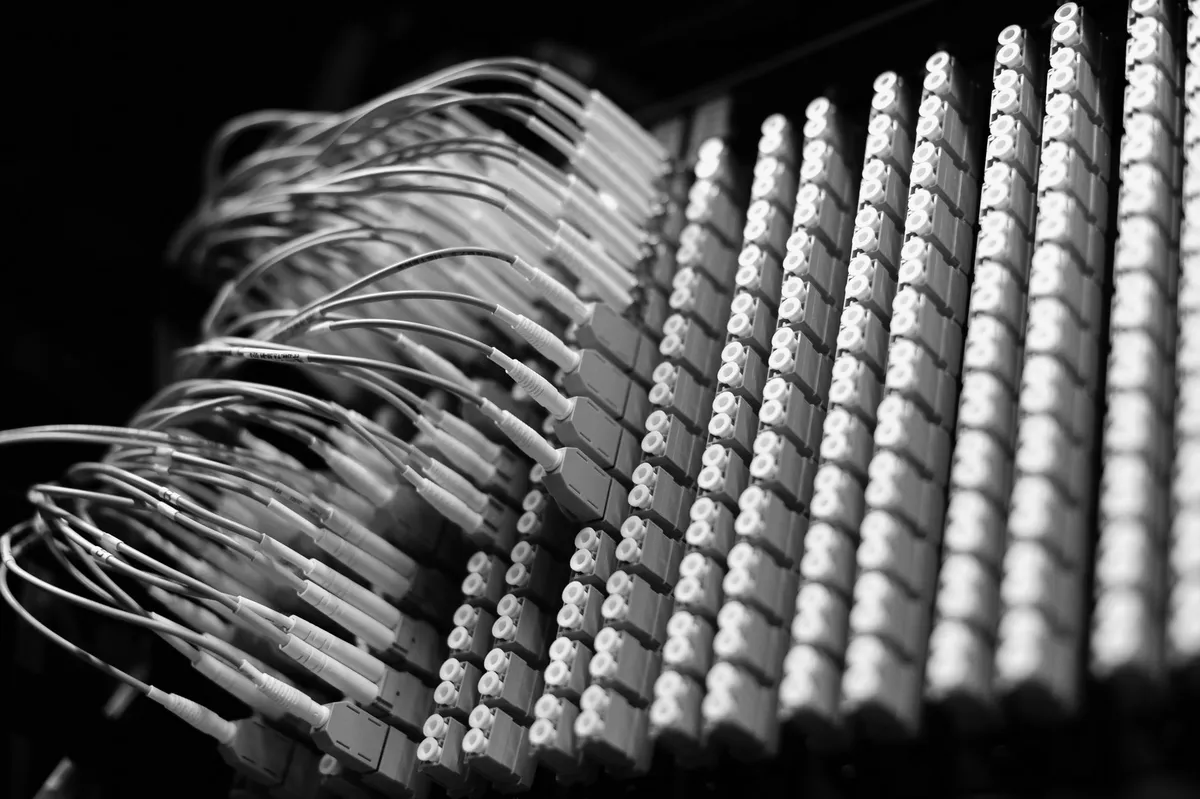
A technician closes the last splice-tray connection in a tight cabinet: to reach the enclosure, the patch cord must make a bend tighter than the design allowed. The next day’s test result shows a loss no one had budgeted for — not a poor splice, not a dirty connector: it is the fibre bent beyond what its category allows. It happens every time a specification simply states “fibre compliant with G.652.D” and stops there, while the installer threads it into a space designed for a very different fibre.
What bend radius means, in one line.
Every optical fibre has a minimum bend radius: the point below which light starts leaking out of the core instead of staying trapped by total internal reflection. The effect is called macrobending and it is a continuous loss, not a one-off event: the tighter the bend, the higher it climbs, and past a certain threshold it climbs almost vertically. A fibre designed for a 30 mm radius, installed at 10 mm, doesn’t “perform a bit worse”: it can lose several dB in a single loop — enough to fail an entire link that looked perfect on paper.
G.652 and G.657: the same glass, different tolerance to bending.
Standard single-mode fibre, ITU-T G.652.D, is what backbones and long runs are built from: excellent in a straight line, but historically characterised only at relatively wide bend radii, around 30 mm. That gap produced a family purpose-built for the places where a bend is unavoidable: ITU-T Recommendation G.657, “Characteristics of a bending-loss insensitive single-mode optical fibre”, with four sub-categories and as many minimum design radii:
- G.657.A1 — 10 mm, fully compliant with G.652.D: it splices into standard fibre without any special precaution.
- G.657.A2 — 7.5 mm, still fully compliant with G.652.D.
- G.657.B2 — 7.5 mm like A2, but only “compatible” with G.652.D: small differences in chromatic dispersion and PMD that normally cause no issues, but do not guarantee formal interchangeability on a mixed run.
- G.657.B3 — 5 mm, built for the last metres inside a building: dense patch panels, apartment entries, interconnects inside a data centre rack.
The difference between category A and category B isn’t only the radius: it’s where you can use it without thinking twice. Category A is built for the whole access network; category B for the last metres, in the “bend-rich” environments the recommendation itself describes.
The same 10 mm bend, three very different losses.
This is why the bare label “G.657” on a specification, with no sub-category, isn’t enough. At the same 10 mm radius and a single turn, the macrobend loss limits manufacturers declare — consistent with the tests set out in IEC 60793-2-50 — are:
- G.657.A1: up to 0.75 dB at 1550 nm (1.5 dB at 1625 nm).
- G.657.A2: up to 0.1 dB at 1550 nm (0.2 dB at 1625 nm).
- G.657.B3: up to 0.03 dB at 1550 nm (0.1 dB at 1625 nm) — a radius that, for this category, is generous.
Twenty-five times the difference between the first and the last, on the exact same physical bend. Tighten to 7.5 mm and the gap widens further: an A2 fibre can reach 0.5 dB, a B3 stays under 0.08 dB. At 5 mm — the radius typical of a shallow wall box — only B3 has a guaranteed limit: 0.15 dB at 1550 nm, 0.45 dB at 1625 nm. An A1, or a G.652.D, bent to that radius has no declared limit at all: no one ever promised it would hold.
Not every “G.652.D” on a specification is the same.
Late-generation G.652.D fibres, sold as “low-loss”, often beat the old G.657.A1’s bend performance straight off the factory floor, while remaining fully compliant with G.652.D. A specification that only says “compliant with G.652.D”, with no macrobend requirement of its own, can just as easily be filled with a fibre like that as with older stock never characterised below 30 mm: the category label alone guarantees nothing at a tight radius. It needs a maximum loss value the manufacturer declares, at the radius actually planned for installation.
The fifth term in the optical budget.
We worked out here the optical budget of a link by adding up cable attenuation, splices, connectors and splitters. There is a fifth line item that calculation doesn’t list because it is normally zero: bend loss, which becomes real every time the design calls for a tighter radius than the fibre chosen can guarantee — a compact cabinet, an unavoidable cable gland, a shallow wall box. Ignoring it doesn’t make it disappear: it just moves it to test day, where an OTDR trace shows it as a loss event indistinguishable, at first glance, from a poor splice. It’s the same physical principle behind the controlled bending used to tap a fibre, around 1 dB: there, the bend is deliberate; here, it’s an installation error — but the physics that produces it doesn’t care which.
Checklist: what to put in the specification.
- Always specify the sub-category (A1, A2, B2, B3), never just “G.657” or just “G.652.D”.
- In racks, dense patch panels and the last metres inside a building, require G.657.B3 or at least A2.
- On long backbone runs, where radius isn’t an issue, G.652.D or G.657.A1 remain the cheaper choice and splice fully into the existing base.
- Have the supplier declare the macrobend loss limit at the minimum radius actually planned for installation, not just the category label.
- On a mixed run with existing G.652.D segments, prefer A1/A2 over B2/B3 wherever full declared compliance is required, not just compatibility.
- Add bend loss to the project’s optical budget whenever a section of the run calls for a radius under 15 mm.
The bottom line.
The right fibre for the right bend almost always costs the same as the wrong one: the difference sits in the label written into the specification, not in the price per metre. It’s one of the first things we check when we design a cable run: wherever the route forces a tight bend — a data centre rack, a building entry, a dense patch panel — the fibre category gets chosen before the cable is ordered, not after the first failed test.
Do you have a project with tight enclosures or dense patch panels and aren’t sure which fibre category to specify? Talk to an engineer about it: checking bend radii is part of every site survey, free of charge.