Which one is fibre 7 in this cable? It depends on the colour code you are using
6 min read
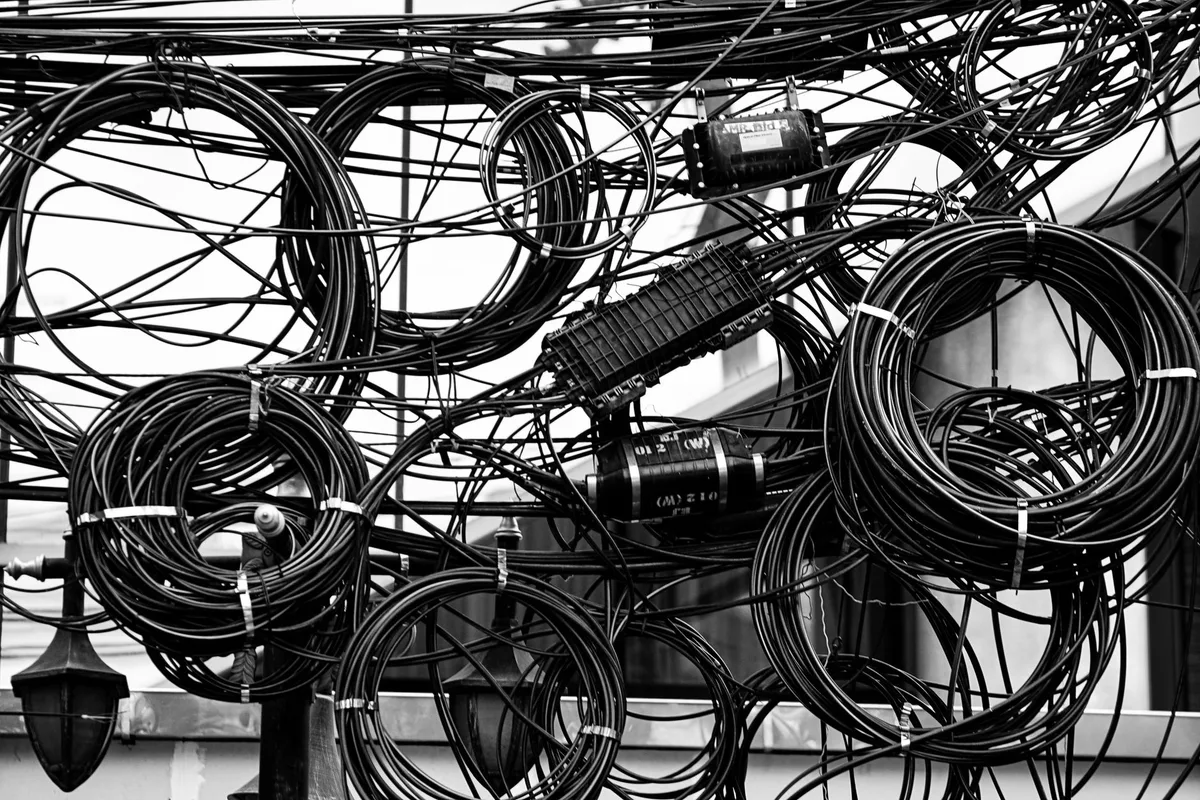
Two drums, two crews, one joint in the middle. The phrase on the phone is always the same: “you splice 7 to 7.” Then two links turn out crossed at acceptance — or nothing turns up, and the bill arrives months later, at night, during a fault. A typical scenario, not a job of ours: the two cables followed different colour schemes and no document said which.
There is no universal colour code, and it is the IEC that says so.
IEC TR 63194:2019, edition 1.0 of 30 January 2019, Guidance on colour coding of optical fibre cables, from subcommittee SC 86A, states it in the scope: decades of discussion of a universal scheme have failed to bring about an agreement, and the document does not promote any listed code above any other. It is not a standard but a collection: seven regional schemes in as many annexes — Germany, North America, Sweden, Switzerland, China, Japan, Brazil. Italy is not among them: here the scheme comes with the cable you bought. The reason is in the document itself: the schemes are embedded in the architecture of the systems they were born in.
Twelve colours, but no standard says which one is fibre 1.
The base colours come from an unexpected place: IEC 60304:1982, edition 3.0, Standard colours for insulation for low-frequency cables and wires, a standard still valid today, written for copper cable insulation. The 2019 technical report makes the decisive point: IEC 60304 defines the twelve colours currently used to identify fibres, but it does not say which colour goes with which fibre number.
The rest sits in the generic specification. IEC 60794-1-1:2023, edition 5.0 of 22 May 2023, Optical fibre cables – Part 1-1: Generic specification – General, has a clause on colour coding (7.2) covering fibres, units and sheath, and cites IEC 60304 among its normative references. But on the intent of the coding — again per the technical report — it uses a phrase worth a contract clause on its own: as agreed. The colour code is not imposed by the standard: it is a matter of agreement, and if it is not agreed the cable supplier decides. A precedent: IEC 60794-2:2002 did define a code, but it matched none in use and no region ever adopted it.
We are not reproducing the full sequences: they sit inside paid documents. And there is no need to learn them — the point is knowing there is more than one.
The buffer tube is the second level, and there the ambiguity doubles.
In a high-count cable a fibre is identified by its position in the tube’s sequence, and the tube in turn. The report devotes a clause to unit and group coding, separate from fibre coding, and documents a fact that surprises: in some schemes the tubes do not all have a different colour. They are counted by position in the stranding, starting from a reference tube — the German scheme in Annex A has a counting code for tubes stranded in a layer, and the Swiss and Chinese annexes show the sequence by position on 18-tube and 24-tube cables.
So “tube 5” may mean the fifth counting in a given direction, not the one with the fifth colour. And counting direction, starting tube and the role of fillers change from scheme to scheme. Beyond the twelfth element it gets harder: the report includes colours for fibres 13 to 16, while other schemes repeat the sequence with an added marking — a detail we cannot verify from open sources, because it lives in the manufacturer’s specification. Which is the point: the route your cable follows is stated by its data sheet, not by an international standard.
The sheath speaks too, and also by convention.
Sheath colour declares the fibre type inside or the expected performance: the technical report distinguishes a historic IEC code from the current one, plus coding by striping. The American reference is TIA-598: on 19 February 2019 the TR-42.12 committee issued a call for interest for revision TIA-598-E, Optical Fiber, Cable, and Component Color Coding, which revises ANSI/TIA-598-D incorporating two addenda — the colours for fibres 13 to 16 and the jacket colour for OM5 indoor cables, the latter started in 2017 as TIA-598-D-2. We could not verify revision E’s publication date from a TIA source: the catalogue is paid and the online store blocks automated checks. One more reason to pin the revision down in the specification.
On the ITU-T side there is nothing: we checked the L and G series index, no recommendation on colour codes. There is ITU-T L.314 (11/2018), Optical fibre identification for the maintenance of optical access networks, a different thing: identifying a live fibre with an instrument, the remedy when colour is no longer enough. Fittingly, the IEC report notes that telling fibres apart without looking for them with light is a key criterion in cable management.
How to find out the scheme of a cable already installed.
- Read the print on the sheath: manufacturer, product code, sequential length marking. From there you reach the data sheet, which is authoritative on the scheme.
- If the print is illegible or the product is out of catalogue, open the cable where accessible — spare length, existing closure — and photograph the cross section with the tubes in their real order.
- Check at least one fibre per tube with an instrument before splicing the lot: the same logic used when choosing between fusion and mechanical splicing.
- When two different batches meet in one joint, assume the schemes differ until proven otherwise.
What to write in the specification, and what to demand in the as-built.
- The coding scheme declared by name and revision, or attached as a data-sheet extract, cable by cable and batch by batch.
- No substitution with a cable using a different scheme without written approval, even at equal performance.
- In the as-built, the fibre–tube–port table must state which convention it is expressed in: numbers alone cannot be interpreted, as with all network documentation.
- Tube counting direction, starting element and treatment of fillers written out in plain words.
- A photograph of the cross section attached to every joint record: ten seconds now, one argument fewer in ten years.
The point.
The colour code is the only part of the network you can read with the naked eye, and the only one nobody puts in writing. You do not need to learn it: you need to declare it. That is why, when we carry out splicing, the cable scheme goes into the joint record alongside the measurements, and in our as-built documentation the mapping table states which convention it is written in — because in ten years a different company will be reading it.
Do you have a site where cables from different suppliers coexist, or an as-built listing numbers with no scheme? Talk to us: site survey and quotation are free, even just to put the mapping back in order.
Sources
- IEC TR 63194:2019 — Guidance on colour coding of optical fibre cables (edition 1.0, 2019-01-30)
- IEC 60794-1-1:2023 — Optical fibre cables, Part 1-1: Generic specification – General (edition 5.0, 2023-05-22)
- IEC 60304:1982 — Standard colours for insulation for low-frequency cables and wires (edition 3.0)
- TIA — Call for interest on TIA-598-E, Optical Fiber, Cable, and Component Color Coding (19 February 2019)